



How the sticker industry quietly split into two very different businesses, and why it matters as your company grows. This is a comprehensive history of modern-day sticker manufacturing.
If you Google custom stickers, you’ll notice there are a ton of companies that look remarkably similar. Most offer instant pricing, online ordering, quick turnaround times, and catchy sticker-related business names.
Over the past 15 to 20 years, an entirely new segment of the sticker industry has emerged, built around convenience, digital printing, and helping customers who need relatively small quantities.
That’s a great thing for consumers; it’s never been easier to buy 50 stickers for your kid’s birthday party this weekend.
Twenty years ago, ordering 50 custom stickers wasn’t easy. Today, anyone can upload artwork, approve a proof, and have a professionally printed sticker delivered within a few days. Companies like Sticker Mule, Sticker Giant, StickerApp, MakeStickers, and dozens of others deserve a lot of credit for making custom stickers accessible to entrepreneurs, small businesses, schools, breweries, artists, and thousands of growing brands.
As these small businesses grow, they often continue buying stickers the exact same way they did when they were a tiny business. Sometimes that’s perfectly fine. Other times, it costs them a surprising amount of money.
The reason has very little to do with negotiating better prices or finding a “cheaper” sticker company. It has everything to do with understanding that there are really two different manufacturing industries hiding under the word stickers.
The Sticker Industry Wasn’t Always Like This
When I first entered this business, most sticker companies looked fairly similar. They were old-school manufacturers with sales reps calling on customers, estimators building quotes, and production managers scheduling work. The business was built around larger volumes and complicated specs.
The internet allowed for a completely different model to emerge. Instead of relying on salespeople, a new generation of companies built businesses around online ordering. Digital printing technology made it possible to produce hundreds of unique orders every day with very little setup time. Customers no longer needed to request a quote or talk to a salesperson. They could simply upload artwork, choose a size, and place an order.
This new model funneled customers into homogeneous versions of the product in order to simplify and demystify the ordering process (i.e., Sticker Mule more or less convinced the world that matte laminate looks cool). Consumers liked the new approach because it was so easy to select the product and get stickers quickly. The success of Sticker Mule, Sticker Giant, and others is obvious and has spread to dozens (maybe hundreds?) of companies competing in the online sticker market.
Traditional sticker manufacturers continued to exist and focused on a completely different market with equipment capable of producing hundreds of thousands, or even millions, of stickers efficiently. These companies are solving a completely different set of problems than the online sticker printing companies.
Two Different Business Models Developed
One big misconception I see is the assumption that every sticker company is competing for the same type of work. They’re not.
Most online sticker printers are optimized for flexibility, quick turns, and wildly low pricing on 50 stickers. Their goal is to make it easy to produce stickers quickly and effortlessly for small businesses. One customer orders 75 stickers for a local coffee shop, and the next orders 250 bumper stickers for their non-profit.
Digital printing is almost universally used for these stickers and is the perfect technology for the job. It requires very little setup, handles frequent artwork changes well, and makes short production runs economical. If your business needs a few hundred stickers, it’s difficult to argue against digital printing.
More robust legacy sticker manufacturers are optimizing for something entirely different. Their goal isn’t to process thousands of unique small jobs every day. Instead, the goal is to manufacture larger quantities as efficiently, consistently, and economically as possible. Those priorities lead to different investments.
Instead of relying primarily on digital printing, industrial sticker manufacturers invest in screen printing, flexo printing, high-volume rotary die cutting, and inline finishing equipment that utilizes specialized tooling designed for long production runs.
Neither approach is better. They’re simply optimized for different customers.
Sticker Volume Increases Should Change the Manufacturing Conversation
Most companies don’t wake up one morning needing 500,000 bulk stickers. Growth happens over time.
A small brand may begin by ordering 250 stickers for their first product launch, but a year later, they’re ordering 2,500. A couple of years later, these orders have ballooned to 10,000 or even 50,000 stickers at a time. Before long, annual purchases reach hundreds of thousands of labels or decals.
Although order quantities have changed dramatically, many companies never change how they buy their stickers. They continue working with the same supplier, using the same printing process, and evaluating quotes the same way they did earlier. That’s completely understandable, after all, they are just stickers.
Or are they?
I would argue that at some point, they’re really buying a manufacturing process.
A company ordering 500 stickers is purchasing a custom-printed product where the materials have been pre-selected and the options are limited.
A company ordering 500,000 stickers every quarter is purchasing a highly manufactured product where every detail has been optimized.
Why Can I Only Find The Newer Sticker Companies?
Online sticker printers are exceptionally good at online marketing. They should be. That’s how their businesses are built. They dominate Google search results and make it incredibly easy to order.
Traditional manufacturers built their businesses differently. Many grew through long-term customer relationships, distributors, sales reps, and referrals rather than search engine optimization.
As a result, buyers searching online often discover one side of the industry while never realizing the other side exists.
That doesn’t mean one group is better than the other. It simply means they were built to solve different problems.
Every Printing Method Has a Sweet Spot
One big misconception in the sticker industry is that there’s a “best” way to print stickers. Digital printing has become so commonplace and widely accepted. Why would an old-school method like screen printing still be necessary?
That’s a little like asking whether a pickup truck is better than a semi truck. It depends entirely on what you’re trying to accomplish.
The same is true in manufacturing. Every printing technology has strengths, weaknesses, and an economic sweet spot. The mistake many buyers make is assuming that because one process worked well when they were ordering 500 stickers, it must also be the best process when they’re ordering 500,000.
That’s rarely the case.
Why Digital Printing Changed the Industry
There’s no question that digital printing has been one of the most important developments our industry has ever seen. Without it, today’s online sticker companies probably wouldn’t exist.
Digital printing made it possible to eliminate much of the setup traditionally required for custom printing. You don’t need printing plates. You don’t need screens. You don’t need to spend hours preparing a press before the first sticker can be produced. That makes digital incredibly efficient for smaller quantities.
If you need 250 custom stickers with a unique design, digital printing is almost certainly the right answer. If another customer needs 500 stickers with completely different artwork five minutes later, the machine can move on with very little downtime.
That’s exactly why digital printing became the foundation of the online sticker industry.
But here’s the catch.
The advantages that make digital printing incredibly efficient at 250 pieces don’t necessarily make it the most economical process at 250,000 pieces.
The Economics Begin to Change
Imagine two different manufacturing philosophies.
The first says:
“Let’s make setup as simple as possible.”
The second says:
“Let’s make production as efficient as possible.”
Digital printing is heavily weighted toward the first philosophy. Industrial manufacturing is often weighted toward the second.
When you’re ordering 100 stickers, setup time is everything. When you’re ordering 500,000 stickers, production efficiency becomes far more important. If you want to learn more about the factors that affect pricing, check out our blog post, How Sticker Pricing Works.
That’s why manufacturing processes start to change as quantities increase. Not because digital printing stops working. Because another process may become more efficient.
What Changes Between 5,000 and 100,000 Pieces?
This is where I think buyers get the most confused.
People often assume there’s a magical quantity where every manufacturer suddenly switches from digital printing to screen printing or flexographic printing.
It doesn’t work that way.
The transition is gradual. Some products still make sense digitally at 25,000 pieces. Others may become better candidates for another process at 7,500.
The material, size, number of colors, and how often it’s reordered all matter. Whether the stickers are supplied on sheets or rolls matters.
The point isn’t that one process always replaces another. The point is that you now have options. Many buyers never realize those options exist.
A Better Way to Think About Quantities
Rather than trying to identify one magic number, I think it’s more helpful to think about how the conversation changes as quantities increase.
Under 1,000 Pieces
This is where online sticker printers shine.
The priorities are speed, convenience, low minimums, and flexibility.
You’re paying for simplicity, and that’s usually money well spent.
1,000 to 5,000 Pieces
Digital printing is still often the right answer.
However, this is the point where it’s worth paying attention to your buying habits.
If you’re ordering the same sticker every month, your annual volume may already justify exploring additional manufacturing options.
5,000 to 10,000 Pieces
This is where we begin to see many companies unknowingly leave money on the table. Not every project changes manufacturing methods here. But enough to say that it’s worth getting another opinion. Especially if the sticker is reordered regularly.
10,000 to 50,000 Pieces
Now, manufacturing starts becoming a much larger part of the conversation. The questions become less about whether someone can print the sticker and more about how it should be produced.
Should it stay digital? Should it move to screen printing? Would changing the layout reduce waste? Could a rotary die improve efficiency?
These aren’t questions most buyers ask. They’re questions manufacturers ask.
50,000 to 250,000 Pieces
At this point, manufacturing efficiency often becomes the primary driver of cost.
The equipment, tooling, production schedule, and finishing process can have a far greater impact on price than negotiating another penny off the quote.
Hundreds of Thousands and Beyond
This is an entirely different world. People outside manufacturing often imagine workers feeding sheets through printers one at a time. Industrial production doesn’t work like that.
Material is produced continuously, and equipment is designed for long production runs.
The focus shifts toward throughput, consistency, quality control, inventory management, and repeatability. You’re no longer optimizing a print job. You’re optimizing a manufacturing process.
What This Looks Like in the Real World
Everything we’ve discussed so far has been about manufacturing theory. So let’s look at an actual example.
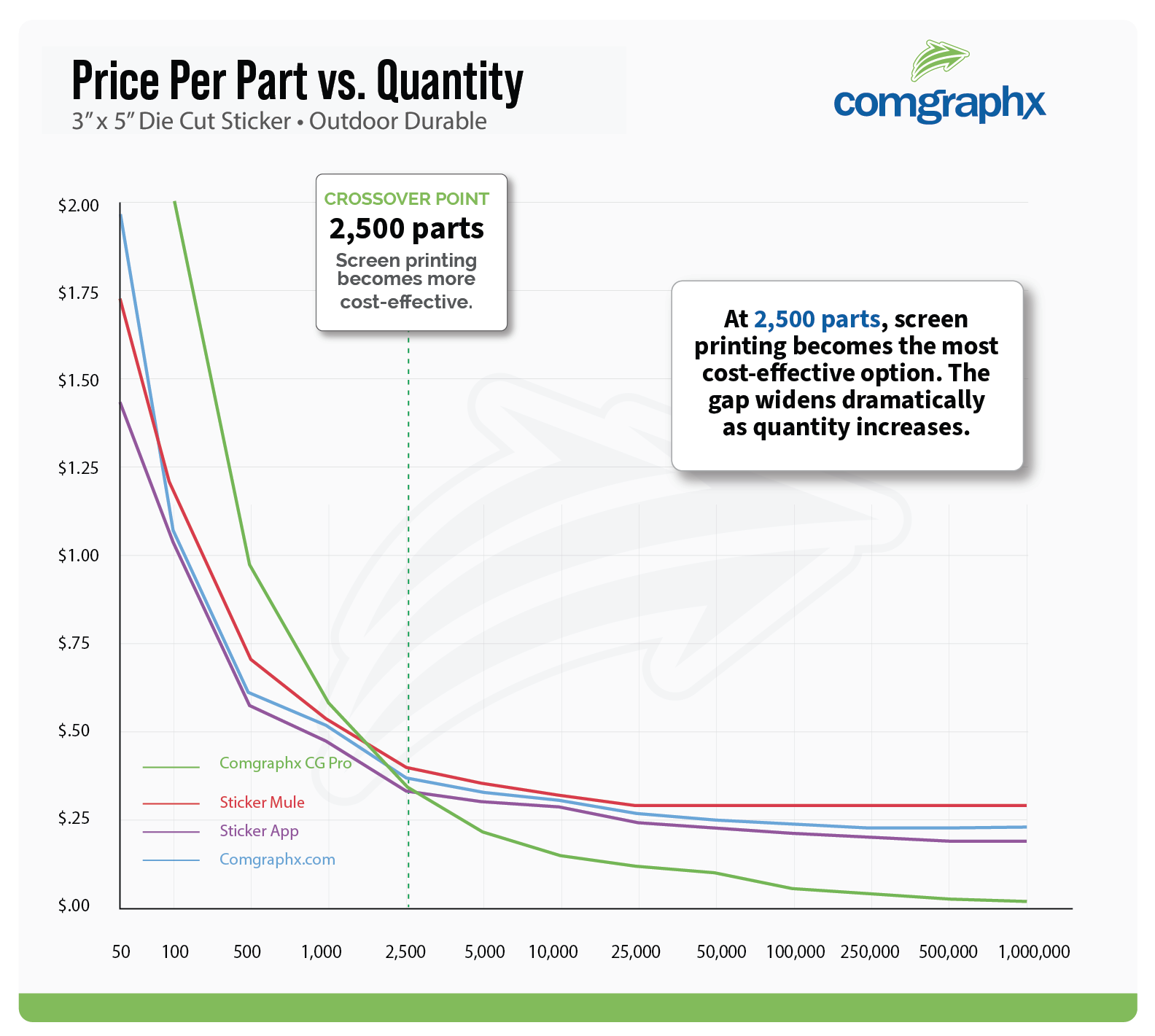
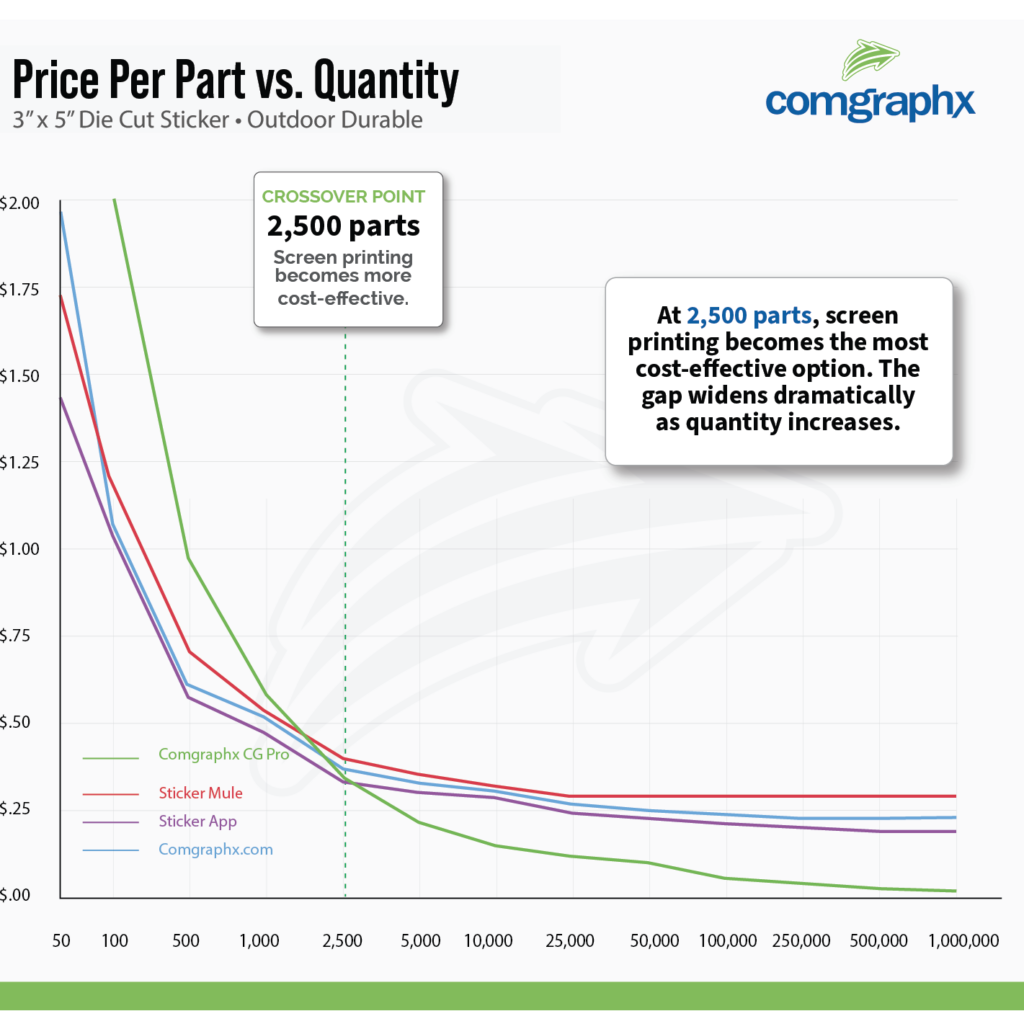
The chart below compares pricing for the same 3″ × 5″ outdoor-durable die-cut sticker across several well-known online sticker printers, our own online pricing, and the same product manufactured using traditional screen printing.
| Quantity | Comgraphx.com | stickermule | stickerapp | Comgraphx cgpro |
| 50 | $ 96 | $85 | $71 | $440 |
| 100 | $119 | $117 | $109 | $446 |
| 500 | $295 | $316 | $289 | $491 |
| 1,000 | $508 | $522 | $464 | $548 |
| 2,500 | $949 | $1,050 | $907 | $706 |
| 5,000 | $1,646 | $1,810 | $1,558 | $985 |
| 10,000 | $3,046 | $3,143 | $2,757 | $1,543 |
| 25,000 | $6,539 | $7,623 | $6,092 | $3,027 |
| 50,000 | $12,632 | $15,060 | $11,378 | $5,280 |
| 100,000 | $23,704 | $29,840 | $21,616 | $9,490 |
| 250,000 | $56,854 | $75,000 | $51,511 | $21,500 |
| 500,000 | $113,642 | $150,000 | $100,473 | $39,400 |
| 1,000,000 | $227,223 | $300,000 | $197,342 | $71,900 |
Methodology
The pricing comparison shown above was designed to compare equivalent products as consistently as possible across multiple online sticker printers. While every company offers different product configurations and pricing models, we made every effort to keep the specifications as similar as possible.
For this comparison, we tried to get comparable specs as listed below:
- Product: Die-cut outdoor sticker
- Size: 3″ × 5″
- Printing: Full-color (CMYK), except screen printing which is 2 colors
- Material: Standard white vinyl
- Laminate: Standard gloss or matte laminate (or the closest equivalent offered by each supplier)
- Adhesive: Permanent
- Shape: Standard die-cut
- Artwork: One design
- Finishing: Individual die-cut stickers (not supplied on rolls or sheets)
- Turnaround: Standard production (no rush service)
Pricing collection date: July 2026.
One caveat to this is that StickerApp might use a BOPP material in place of vinyl. That’s because they use lasers to cut out their stickers (as shown on their social media posts), and vinyl can not be cut using lasers. This claim has not been verified.
Prices were collected directly from each company’s public online pricing calculator whenever possible. Our screen-print pricing reflects pricing for the same product manufactured through our high-volume production process.
To make the comparison as consistent as possible:
- Standard online pricing was used.
- Promotional discounts, coupons, first-order offers, and temporary sales were excluded whenever possible.
- Shipping, taxes, and other optional fees were not included unless they were unavoidable within a supplier’s pricing system.
Because pricing, promotions, production methods, and product offerings change over time, the figures shown here should be viewed as illustrative rather than permanent price quotes. The purpose of this comparison is not to declare one company universally cheaper than another, but to demonstrate how different manufacturing methods can become more or less economical as production volumes increase.
Observations of sticker pricing
A few observations immediately stand out.
At lower quantities, the online sticker companies are extremely competitive. In fact, they often beat our own online pricing (by a few dollars, often because they are targeting very small orders). That’s exactly what they were built to do.
As quantities increase, something interesting begins to happen.
Around the 1,000 to 2,500 piece range, screen printing becomes the more economical manufacturing process for this particular product. From there, the gap continues to widen.
By the time annual quantities reach hundreds of thousands of stickers, the difference is no longer measured in a few hundred dollars. It can be tens of thousands—or even hundreds of thousands—of dollars.
Again, this doesn’t mean screen printing is always cheaper.
It doesn’t mean online sticker companies are charging too much.
And it certainly doesn’t mean every sticker should be screen printed.
It simply illustrates the central idea of this article:
As production volumes increase, the manufacturing process itself often becomes the single biggest driver of cost.
A Real Example
A few months ago, we quoted a project for a company purchasing approximately 500,000 labels.
They had been buying from one of the larger online sticker printers for roughly $0.28 per label. Our quote came in around $0.05.
Out of curiosity, we also priced the same project through another well-known online printer. Their price was roughly $0.13. That was a substantial improvement over the original quote. It was still more than double ours.
If you put those prices in terms of real dollars, you’ll see just how dramatic the price difference is.
Comgraphx – $25,000
Online Competitor # 1 – $140,000
Online Competitor # 2 – $65,000
It’s important to understand and think more deeply about what this example shows. It doesn’t mean one company is always cheaper than another. It doesn’t mean online sticker printers are overpriced. It doesn’t mean every 500,000-piece order should cost five cents. Every project is different. Different materials, adhesives, colors, finishes, and production requirements all affect pricing.
What this example demonstrates is something much more important. At certain volumes, the manufacturing process itself becomes the biggest factor in determining cost. The customer wasn’t paying more because they had negotiated poorly. They were paying more because they were still buying through a manufacturing model optimized for much smaller production runs.
That’s a completely different issue.
The Internet Changed How We Buy Stickers
One observation I’ve made over the past decade is that the internet has become incredibly good at helping people buy small quantities of stickers.
The unintended consequence is that many purchasing managers assume those same companies remain the best option as their businesses continue growing.
Sometimes they are. Sometimes they aren’t.
Google doesn’t know how many stickers you’re ordering every year. It doesn’t know whether this is your first order or your thousandth. It certainly doesn’t know whether a different manufacturing technology could reduce your costs by 30%, 50%, or more.
That’s why buyers often continue purchasing stickers exactly the same way long after their manufacturing needs have changed. And most of the time, nobody tells them they’ve crossed that line.
Where Comgraphx Fits In
One of the interesting things about our company is that we actually live in both worlds.
Like many of the online sticker companies, we built an online ordering system where customers can upload artwork, receive instant pricing, and order die-cut stickers in just a few minutes. If you need 100 die-cut stickers for a new product launch or a few hundred labels for an upcoming event, that’s exactly why our online platform was built.
Small orders shouldn’t require phone calls, sales meetings, or waiting two days for a quote. The online sticker companies got that part right, and we believe customers deserve that same convenience.
But that’s only half of our business.
The other half looks much more like a traditional manufacturing company. We work with purchasing managers, engineers, operations teams, marketing departments, and large brands that buy the same products month after month, year after year.
Some customers order 5,000 stickers every few months. Others order 50,000 at a time. Some order millions of labels annually across dozens of different SKUs.
Those customers usually aren’t looking for another website where they can upload artwork.
They’re looking for someone who understands manufacturing.
Sometimes that means recommending a different printing process. Sometimes it means changing materials to improve durability or reduce cost. Sometimes it’s redesigning a layout to produce more labels per roll or reducing waste during production.
Those conversations rarely happen inside an online shopping cart.
That’s where having experienced people still matters.
The Right Question Isn’t “Who’s Cheapest?”
When someone asks us for a quote, we don’t begin by asking how we can beat another company’s price. We begin by asking whether the product is being manufactured the right way.
Sometimes the answer is yes.
We’ve quoted plenty of jobs where an online sticker printer was already very competitive, and we’ve told customers exactly that. If digital printing is the best manufacturing process for the project, there’s no reason to pretend otherwise.
Other times, we discover that a customer has quietly outgrown the process they’ve been using for years. That’s where the biggest savings usually come from. Not because someone negotiated harder. Not because another company accepted a smaller profit margin.
Because the manufacturing process changed.
How Do You Know When It’s Time?
There isn’t a magic number.
Some products reach that point around 5,000 pieces.
Others may not until 50,000 or more.
The materials, colors, construction, durability requirements, and reorder frequency all matter.
But there are a few signs it’s worth asking the question:
- You’re ordering the same sticker or label over and over.
- Annual purchases have grown significantly.
- Your quantities continue to increase each year.
- Sticker costs have become a meaningful expense in your business.
- Nobody has discussed different manufacturing options with you.
- You would like to explore net 30 terms for your sticker and label purchases
- You have a unique challenge where a person might be helpful
If several of those sound familiar, it may simply be time to get another opinion.
You don’t have to change suppliers. You don’t have to abandon online ordering. You just owe it to yourself to make sure you’re buying the right manufacturing process.
Final Thoughts
The internet made buying stickers dramatically easier, and that’s something worth celebrating. Millions of businesses have benefited from companies that simplified custom printing and made small orders accessible to everyone.
But as businesses grow, the questions eventually change.
The conversation stops being about how quickly someone can print a few hundred stickers and starts becoming a manufacturing conversation.
That’s the point where many buyers unknowingly continue shopping in the same market they started in years earlier.
The good news is that there are more options than most people realize.
If your company has grown from ordering a few hundred stickers to tens of thousands—or hundreds of thousands—it may be worth taking a fresh look at how those products are made.
You may discover that you haven’t outgrown stickers after all. You’ve simply outgrown the manufacturing process you started with.
Wondering if you’ve outgrown your current sticker supplier?
We’ll gladly review your current sticker or label program and let you know whether you’re already using the most economical manufacturing process. If you are, we’ll tell you. If there’s a better option, we’ll explain why.